British weather can make a simple vlog unexpectedly difficult. Bright sunshine can disappear behind cloud within minutes, light drizzle may arrive without warning, and wind can ruin an otherwise perfectly usable piece to camera.
The challenge is not simply keeping the image bright enough. Grey skies flatten contrast, wet streets create reflections, and changing conditions force a creator to make quick decisions about exposure, audio and whether it is sensible to keep filming at all.
A good travel setup therefore needs to be quick, compact and easy to protect.
Flat grey light is not always bad light
Overcast skies often look dull to the eye, but they can actually be useful for filming people.
Cloud acts like a large diffuser, softening shadows across the face and reducing the harsh contrast created by direct midday sun. For a walking vlog or street interview, that can produce more flattering skin tones with less effort.
The problem is separation.
When the sky, pavement and buildings all sit within similar grey tones, the image can feel flat. The answer is not necessarily to increase exposure dramatically. Instead, look for colour and depth in the scene.
Red buses, shop fronts, wet pavement, brickwork and street lighting can all provide visual contrast. Moving the subject farther from the background also helps create a stronger sense of depth.
When choosing a vlog camera for this kind of shooting, dynamic range, stabilisation and fast operation are often more useful than simply chasing the highest resolution.
Protect the highlights even when the sky looks dull
A grey sky may appear dim, but it can still be much brighter than a person’s face.
If exposure is pushed too far, cloud detail disappears into a white patch while the street below still looks relatively dark. This is why dynamic range matters in British weather.
It is usually better to protect the bright sky and lift darker areas carefully later than to completely clip the highlights during recording.
Shooting in a flatter colour profile can also provide more flexibility for creators who are comfortable grading footage afterwards.
The important thing is to judge the whole frame, rather than assuming that overcast weather means there is little contrast to manage.
Drizzle changes the way you should use the camera
Light rain is one of the most common problems for travel vlogging in the UK.
A few drops may not look serious, but the Osmo Pocket series is not designed as a waterproof camera. DJI states that bare Osmo Pocket devices are not waterproof and that exposure to water can affect their precision electronic components.
That changes how the camera should be used in drizzle.
Instead of walking for half an hour with the camera permanently exposed, record short sequences when conditions allow, then return it to a protected pocket or bag. Filming under shop awnings, station entrances or other covered areas can keep the vlog moving without unnecessarily exposing the camera to moisture.
If rain becomes more than occasional droplets, putting the camera away is the sensible choice.
A lens cloth is more useful than it sounds
Even when the camera body remains protected, one small drop on the front element can ruin several minutes of footage.
Because the lens is small, water spots can be difficult to notice on the screen. Against lights or a bright grey sky, they may produce obvious blur or flare later.
A small clean microfibre cloth should therefore be part of the basic kit.
Check the lens whenever the camera comes back out of a pocket or bag. It takes only a few seconds and is far easier than trying to repair soft footage in editing.
Avoid wiping the lens with a sleeve or wet clothing, as that can simply spread moisture and dirt across the surface.
Wind is often a bigger problem than drizzle
Bad audio can make a vlog unusable even when the picture looks excellent.
Wind hitting a camera microphone creates low-frequency rumble and distortion that is difficult to remove completely afterwards. Sheltering the camera behind a building or turning your body into the wind can help, but a dedicated microphone with a proper windscreen is much more reliable.
This is especially important on seafronts, bridges, exposed city streets and hilltop viewpoints.
The current Osmo Pocket 4 and Pocket 4P support direct connection with compatible DJI Mic transmitters through the OsmoAudio system. DJI’s Pocket 4 Vlog Combo, for example, includes a DJI Mic Mini 2 transmitter and windscreen.
For a solo creator, that means the microphone can stay on the presenter while the camera remains farther away, without requiring a conventional receiver mounted to the camera.
Osmo Pocket 4P suits difficult grey-light scenes particularly well
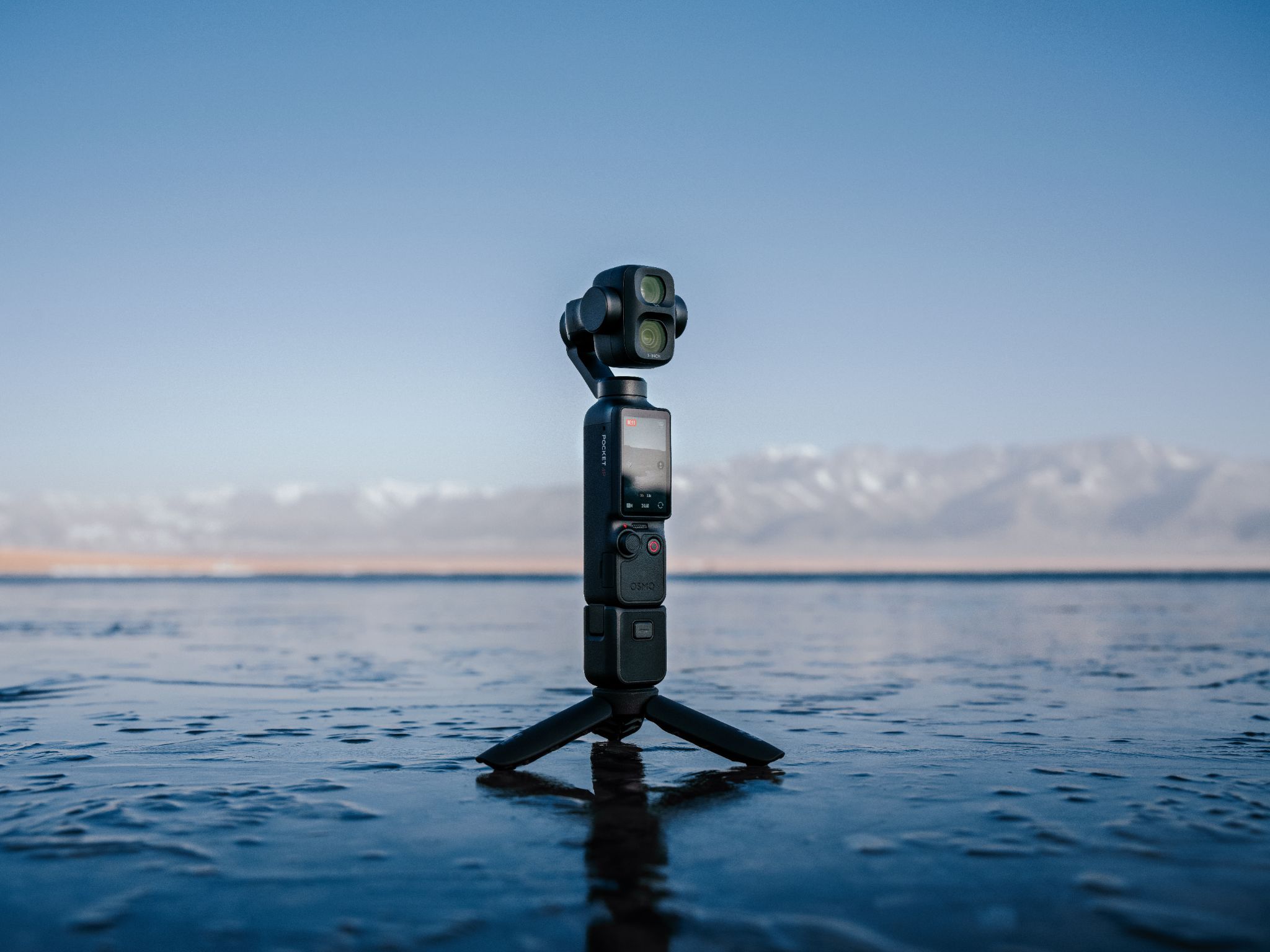
For creators who regularly vlog outdoors, the Osmo Pocket 4P is the most capable option in the current Pocket range.
Its wide-angle camera uses a new 1-inch stacked CMOS sensor with a 20mm-equivalent f/2.0 lens. In D-Log 2, DJI specifies up to 17 stops of dynamic range, giving more room to retain both bright skies and darker foreground detail in high-contrast scenes.
That is especially useful in typical British conditions.
A street may be relatively dark while a bright overcast sky fills half the frame. The wider dynamic range gives more flexibility when balancing those areas in post-production.
The wide camera also works well for walking pieces to camera, narrow streets and interiors when bad weather forces filming indoors.
The 60mm camera adds a different look without changing gear
Pocket 4P also includes a dedicated 60mm-equivalent med-tele camera with a 1/1.28-inch sensor and f/1.8 aperture.
That lens is useful when grey weather makes a wide street scene feel visually flat.
A longer focal length compresses perspective and isolates details more strongly. A presenter standing in front of wet city lights, a café window or a row of terraced houses can look more visually separated from the background than with a wide-angle view.
The 60mm option also helps capture architectural details, signs or street scenes from slightly farther away without carrying a second camera.
For a travel creator moving between rain showers, that ability to change visual style without swapping lenses is particularly convenient.
Three-axis stabilisation helps when you need to move quickly
When the weather is uncertain, there is often little time to set up a tripod.
Osmo Pocket 4P and Pocket 4 both use three-axis mechanical stabilisation. That allows the creator to walk, turn or quickly capture a street scene while maintaining a smoother image than would normally be possible handheld.
This is especially useful when filming between showers.
A short break in the rain might last only a few minutes. A pocket gimbal camera can be taken out, powered up and used immediately rather than requiring a larger camera and separate stabiliser to be assembled.
That speed is one of the main reasons the Pocket format works so well for unpredictable travel conditions.
Pocket 4 is the simpler choice for most everyday vlogs
Not every creator needs the dual-camera system of the Pocket 4P.
Osmo Pocket 4 uses a new 1-inch CMOS sensor with a 20mm-equivalent f/2.0 lens and offers up to 14 stops of dynamic range in supported modes. It also provides three-axis mechanical stabilisation and the updated ActiveTrack system.
For walking vlogs, cafés, city streets and normal travel footage, that combination already covers most situations.
It also has 107GB of built-in storage and a quoted operating time of up to 240 minutes under DJI’s controlled 1080p/24fps test conditions.
That makes Pocket 4 particularly attractive for creators who want one compact camera and do not regularly need the portrait-style 60mm perspective.
Pocket 4P becomes more worthwhile when the vlog relies more heavily on cinematic portraits, street details and stronger separation between subject and background.
ActiveTrack can help when wind makes tripod filming awkward
A small tripod is useful for solo pieces to camera, but windy conditions can make exposed setups less comfortable.
Where conditions are safe, placing the camera on a stable surface and using ActiveTrack allows a creator to move through the scene without a camera operator.
Pocket 4 supports the updated tracking system at up to 4× zoom, while Pocket 4P extends tracking across a much wider zoom range.
The practical benefit is not the maximum zoom figure itself.
It is being able to frame a short walking introduction or stand farther from the camera while it keeps the subject positioned automatically. That is useful when there is only a brief dry window and repeated takes would waste time.
A lightweight tripod should still be placed carefully. Strong wind is a reason to move to a more sheltered position, not to trust tracking while the camera itself is unstable.
Grey weather can actually improve the story
A British travel vlog does not need to pretend every day is sunny.
Wet pavements reflect shop lights. Mist can create depth. Low cloud changes the look of hills and coastal scenes. A sudden shower can become part of the story rather than an interruption to it.
The key is using equipment in a way that matches the conditions.
For a straightforward travel workflow, Osmo Pocket 4 offers a strong combination of a 1-inch sensor, mechanical stabilisation, tracking and generous built-in storage. For creators who want more control over difficult light and more variety from a single small camera, Pocket 4P adds the wider dynamic range of its main camera and a dedicated 60mm f/1.8 med-tele lens.
Neither should be treated like a waterproof action camera. In drizzle, the better strategy is to protect the camera, work quickly between showers and put more attention into wind protection for the microphone.
British weather may be unpredictable, but it does not have to produce unpredictable footage.