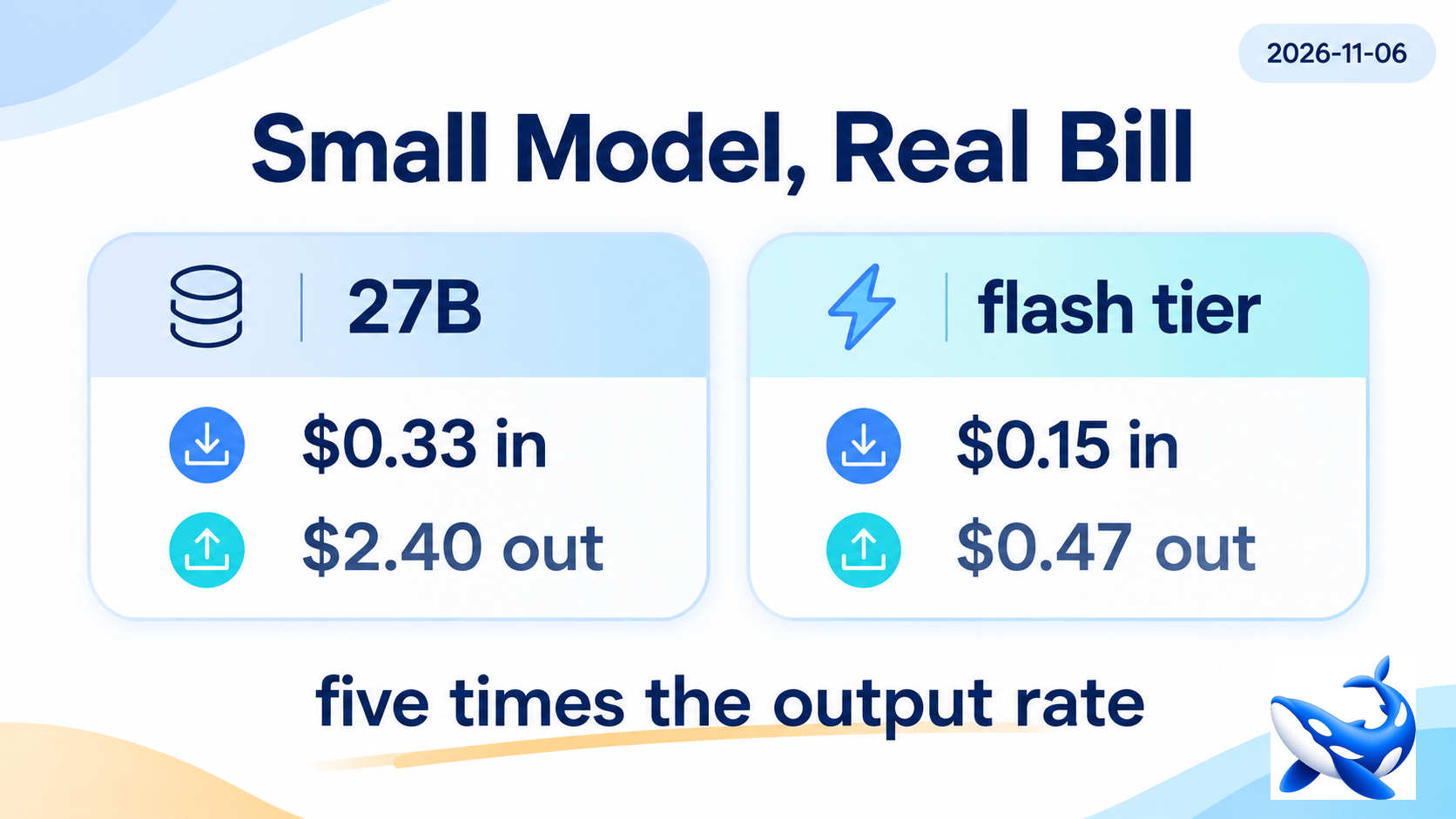
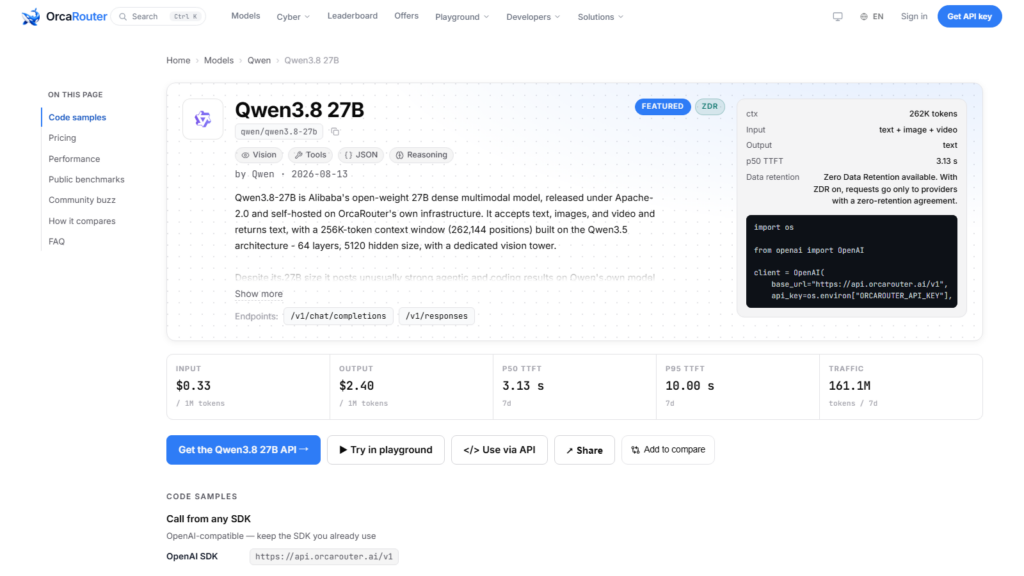
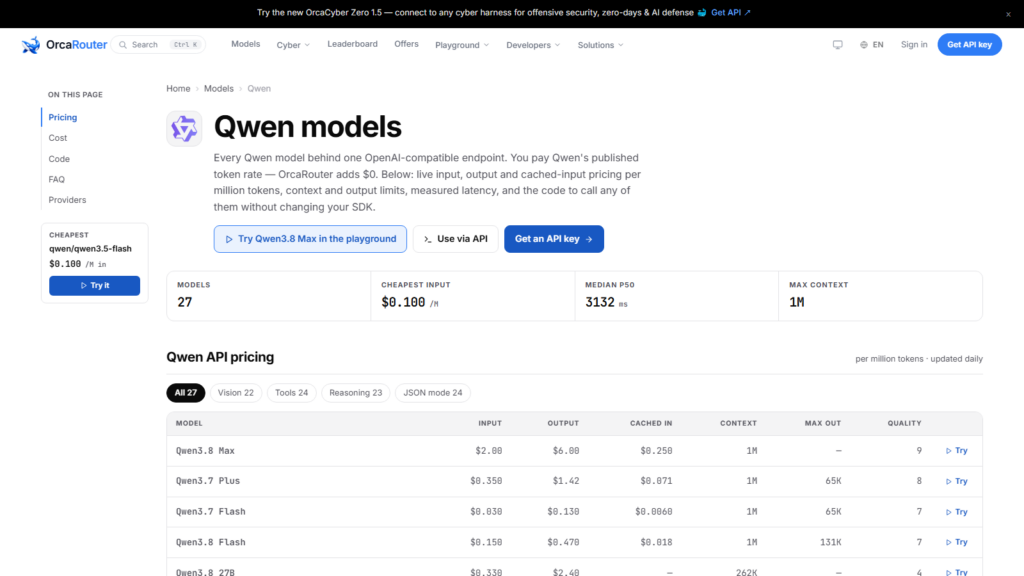
On OrcaRouter parameter count and price point in opposite directions. Parameter count is a mental shortcut with a bad direction of inference. A 27B model sounds like the light option — smaller than the 400B-class flagships, cheaper to run, therefore cheaper to buy. Qwen3.8 27B API on OrcaRouter charges $0.33 in and $2.40 out, and the second number is where the shortcut breaks: it is 5.1× the output rate of a 400B-class flash card at $0.47 [OURS].
Smaller weights lower the cost of *running* the model. They do not lower the price of *buying* it — that is a commercial decision, and on this card the output rate carries a specialist premium.
The comparison that matters
| card | input | output | output multiple |
| Qwen3.8 27B | $0.33 | $2.40 | 1.00× |
| Qwen3.8 Flash | $0.15 | $0.47 | 0.20× |
| DeepSeek V4.1 Flash 1017 | $0.15 | $0.60 | 0.25× |
| MiniMax M3.1 Flash | $0.15 | $0.60 | 0.25× |
The input gap is modest — 2.2× — and the output gap is the whole story. On a 3:1 blend this card’s effective rate is `(3 × 0.33 + 2.40) / 4 = $0.8475` per million, against `(3 × 0.15 + 0.47) / 4 = $0.23` on the flash card [OURS]: 3.7×, not the 2.2× an input-only comparison suggests.
Why a specialist costs more per token
Because the card is not selling tokens; it is selling a result on a narrow class of work. The published rows make the class explicit: GPQA Diamond 90.5, LiveCodeBench v6 90.3, OSWorld-Verified 84.3 [VENDOR] — graduate science and competitive programming at flagship level from a 27B checkpoint.
If your task is in that class, the alternative is not the flash card; it is a flagship at $10 and $50. Against that comparison this card is 21 times cheaper on output and the pricing question disappears.
If your task is not in that class, the specialist premium is buying nothing. That is the honest test, and it has nothing to do with parameter count.
Priced per task, three ways
Document classification. 2,000 input, 50 output: $0.00066 + $0.00012 = $0.00078 [OURS]. Ten thousand a month is $7.80. On the flash card the same is $0.00032 — the difference is real and immaterial.
A hard extraction. 8,000 input, 800 output: $0.00264 + $0.00192 = $0.00456. A thousand a month is $4.56, against $1.58 on the flash card.
A repeated-context session. 60,000 tokens sent twenty-one times, 1,000-token answers: $0.4158 of input (no cache rate is published, so all of it pays full price) plus $0.0504 of output — $0.466 [OURS]. On a card with a 2% cache rate the input side would be about $0.013.
The third case is where this card is genuinely expensive, and it is a property of the blank cache field rather than the output rate.
What makes the premium defensible
One number from the telemetry: 0.090% error rate over seven days [OURS]. That is the lowest in this batch, and on a batch pipeline with no retry logic it is worth more than a cheaper output rate. A card that fails once in a thousand requests costs you a thousandth of a re-run; a card that fails once in a hundred costs you a hundredth, and at ten thousand documents that is a hundred documents.
The other defensible feature is the benchmark profile itself: a narrow specialist that scores at flagship level inside its class. That is what the output premium buys, and it either matches your workload or it does not.
What the 27B is actually competing with
Not the flash tier. The card’s natural rival is the flagship, and the comparison there is stark.
At $10 and $50, a flagship’s output costs 20.8 times this card’s $2.40; on a 3:1 blend the multiple is about 24× [OURS]. For a workload that genuinely needs flagship reasoning on a narrow class of questions, a specialist at a tenth of the price is the obvious buy — provided it can answer them, which is exactly what the benchmark rows are claiming.
Against the flash tier the card is 3.7× more expensive on a blend and, on the tasks where it is a specialist, likelier to be right. Against the flagship it is 24× cheaper and likelier to be wrong outside its class.
The purchase is therefore a bet on which class your traffic belongs to. That is a question about your work, and no parameter count answers it.
What the specialist is for, concretely
Three tasks where the premium is clearly justified, and three where it is not.
Justified: graduate-level science questions in a domain you have already narrowed; competitive-programming-style problems where correctness is checkable; structured extraction from documents that defeat a flash card.
Not justified: classification of support tickets (the flash card is right far more often than the price difference suggests); summarisation of well-structured text; anything where the answer will be reviewed by a human who can fix it cheaply.
The boundary is whether a wrong answer costs more than 3.7× the token price — the blended multiple over the flash card. If a wrong answer is a rerun, use the flash card. If it is an expert hour, use the specialist.
That single sentence is the whole purchasing rule, and it applies to every specialist card in the catalogue, not just this one.
How to test the claim cheaply
The benchmark rows are the card’s argument, and they are testable for the price of a coffee.
Take fifty questions from your own domain whose answers you already know, run them through this card and through a flash card, and score blind. At 8,000 input and 800 output tokens, fifty requests cost $0.13 here and $0.08 on the flash card [OURS].
What you are looking for is not “which is better” but “where does the gap appear”. If the specialist wins on the questions you actually ask, the 3.7× is buying something; if the two tie, it is buying a benchmark.
That fifty-question test is more informative than any row on the card, because it uses your distribution rather than the vendor’s.
The number to carry away
3.7× — the blended premium over a flash card — against 24× cheaper than a flagship. Between those two multiples sits the entire decision, and which one applies depends on whether your work is in the specialist’s class.
The takeaway
A 27B is not a budget option: at $0.33 and $2.40 this card’s output rate is 5.1× a flash-tier card’s, and its blended premium is 3.7× — against a flagship’s $50, still 21 times cheaper. Price the work, not the parameter count: on the specialist’s own class the premium buys a result, and on everything else it buys nothing.
Sourcing note: pricing and context are catalogue records; latency, throughput, error rate and traffic figures are OrcaRouter production telemetry for the seven days ending 2026-11-05 [OURS]. Benchmark rows are published on the model page and reproduced as the vendor’s claims [VENDOR]. Per-task costs use the stated token counts and published rates; the repeated-context example assumes no cache, since the card publishes no cache rate. Checked 2026-11-06.