What Is the Full Form of VVT?
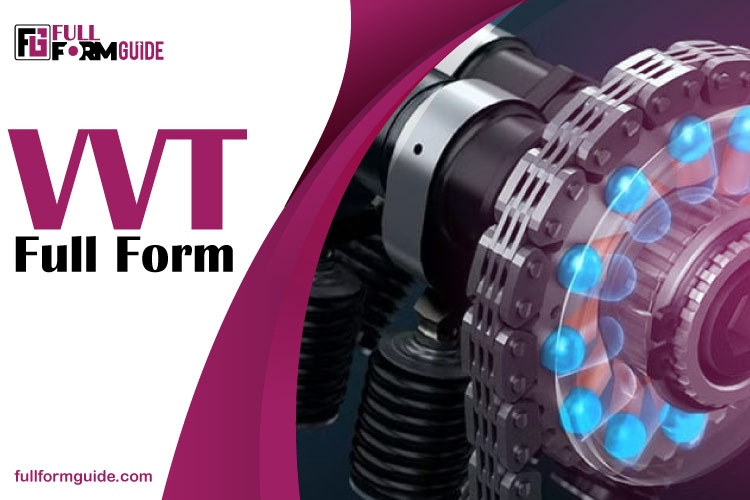
The full form of VVT is Variable Valve Timing.
It is an engine technology used in modern automobiles to improve performance, fuel efficiency, and emissions control by adjusting the timing of the engine valves according to driving conditions.
What Is VVT in Cars?
Variable Valve Timing (VVT) is an advanced system that allows the engine to change the timing of the intake and exhaust valves during operation.
By optimizing when valves open and close, VVT helps the engine:
- Deliver more power at high speeds
- Improve fuel economy at low speeds
- Reduce harmful emissions
This makes VVT engines both powerful and efficient, giving drivers the best of both worlds — performance and mileage.
How Does VVT Work?
The engine valves control the air-fuel mixture entering the engine and the exhaust gases leaving it.
In traditional engines, valve timing is fixed, meaning it doesn’t change regardless of speed or load.
VVT, however, automatically adjusts valve timing based on factors like:
- Engine speed (RPM)
- Throttle position
- Load and temperature
This is achieved using:
- Camshaft phasers or hydraulic actuators
- Oil control valves (OCV) controlled by the Engine Control Unit (ECU)
These components rotate the camshaft slightly to advance or retard valve timing, allowing the engine to breathe more efficiently at different RPMs.
History of VVT Technology
The concept of variable valve timing was introduced in the 1980s.
It was first implemented by Alfa Romeo in its Spider 2000 model, and later popularized by Japanese automakers such as:
- Toyota (VVT-i – Variable Valve Timing with intelligence)
- Honda (VTEC – Variable Valve Timing and Lift Electronic Control)
- Mitsubishi (MIVEC – Mitsubishi Innovative Valve timing Electronic Control)
- Nissan (VVL – Variable Valve Lift)
Today, almost all modern car manufacturers use some form of VVT system to optimize engine performance.
Types of Variable Valve Timing Systems
| Type | Description | Example |
| VVT | Basic variable valve timing system | Toyota, Suzuki |
| VVT-i | Variable Valve Timing with intelligence (ECU controlled) | Toyota, Lexus |
| DOHC VVT | Dual Overhead Camshaft system | BMW VANOS |
| VTEC | Variable Valve Timing & Lift | Honda |
| MIVEC | Variable Valve Timing and Lift Control | Mitsubishi |
Each system uses slightly different technology but the goal is the same — balance power, efficiency, and emissions.
Benefits of VVT Technology
- Improved Engine Performance: Delivers more torque and power when needed.
- Better Fuel Efficiency: Optimizes air-fuel mixture for better combustion.
- Reduced Emissions: Cleaner exhaust gases and compliance with emission standards.
- Smooth Driving Experience: Seamless transition between low and high RPM ranges.
- Longer Engine Life: Improved combustion reduces strain on engine components.
Disadvantages of VVT
- Complex System: Requires precise control and maintenance.
- Higher Repair Costs: Components like OCV or cam phasers can be expensive.
- Oil Sensitivity: Poor-quality engine oil can affect VVT operation.
Despite these, the advantages far outweigh the drawbacks, especially for modern vehicles.
VVT in Popular Car Brands
- Toyota: VVT-i and Dual VVT-i systems
- Honda: i-VTEC (intelligent Variable Valve Timing and Lift Electronic Control)
- Suzuki: K-Series engines with VVT
- BMW: VANOS and Valvetronic systems
- Hyundai/Kia: CVVT (Continuously Variable Valve Timing)
Conclusion
The VVT full form, Variable Valve Timing, represents one of the most important innovations in modern automotive engineering.
By intelligently controlling valve operation, VVT helps engines deliver higher power, better fuel economy, and lower emissions.In short, VVT is the technology that makes today’s cars smarter, cleaner, and more efficient.