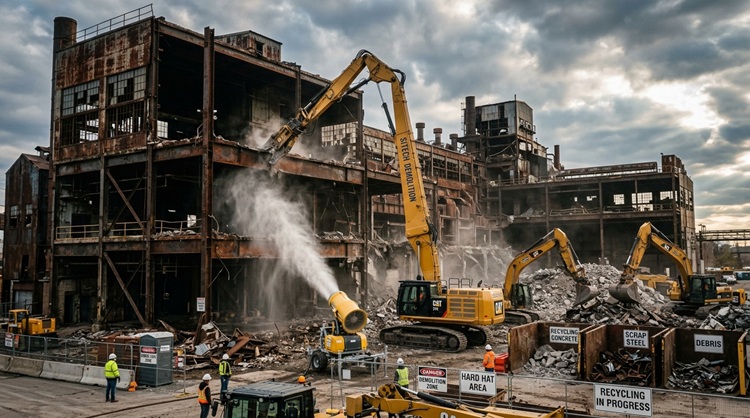
Ensuring safety in heavy industrial settings is a constant, evolving priority. Advances in industrial technology continue to reshape how companies safeguard their employees, minimize accidents, and improve risk management. As these environments demand more adaptive and intelligent safety mechanisms, new solutions are emerging to help companies stay ahead. For operations seeking specialized support for high-risk environments, industrial demolition services can offer tailored expertise.
The rapid integration of breakthrough technologies, from wireless emergency systems to immersive simulation training, is setting new standards throughout the industry. Not only do these innovations reduce hazards, but they also improve productivity, compliance, and workforce confidence. In this article, discover the critical advancements protecting today’s heavy industrial workforce and transforming historic safety protocols.
Wireless Emergency Stop Systems
Historically, emergency stop functions in large-scale industrial environments relied on stationary, hardwired systems. This setup posed challenges when rapid response was required across dynamic, wide-ranging worksites. The emergence of wireless emergency stop systems has helped address these limitations by enabling operators to remotely halt machinery from a safe distance. This increased mobility enhances flexibility and real-time risk mitigation, particularly in environments with moving vehicles, heavy equipment, or constantly changing work conditions. As a result, response times during emergencies can be significantly reduced.
Furthermore, as demand for flexible and streamlined operations continues to grow, wireless emergency stop systems are becoming an increasingly valuable component of workplace safety strategies. These systems can integrate with broader operational control platforms, allowing safety personnel and supervisors to coordinate responses across multiple work areas more effectively. Their applications extend beyond manufacturing and mining, with industries such as construction, logistics, and chemical processing also recognizing their safety benefits. By leveraging real-time wireless communication and robust fail-safe mechanisms, organizations can improve emergency response capabilities, minimize operational disruptions, and help ensure that equipment remains in a safe state whenever hazards arise.
Autonomous Inspection Robots
Routine inspections are essential in industrial settings but are often fraught with risks, especially in hazardous zones where accidents can occur. The deployment of autonomous inspection robots, such as those implemented by ADNOC, is transforming this landscape. These robots are equipped with technologies such as 3D LiDAR and specialized cameras that enable them to operate in dangerous areas, detecting leaks, temperature hotspots, and other anomalies without putting personnel at risk. This not only improves safety but also enhances data accuracy and operational uptime.
Recent advancements in autonomous inspection robotics have made them more versatile than ever before. Many robots now have machine learning capabilities that enable them to recognize abnormal patterns beyond predefined thresholds. The integration of cloud-based analytics has enabled real-time reporting, so maintenance and safety teams are notified of emerging issues immediately. This has been instrumental in reducing repair times, optimizing maintenance schedules, and allowing for predictive rather than purely reactive approaches to safety management. Autonomous robots are also helping companies meet strict regulatory standards, as the digital logs they generate serve as reliable evidence of compliance and as a basis for system integrity checks.
Advanced Sensor Technologies
The application of sophisticated sensor systems plays a crucial role in accident prevention. Solutions such as Expro’s Catwalk Sensor system deliver real-time alerts for personnel during critical operations. Their visible and audible notifications act immediately if materials enter potentially dangerous zones, giving employees vital time to react. These sensors have been proven to help reduce workplace injuries in environments where heavy manual handling and moving components are common, as highlighted in numerous Occupational Safety and Health Administration guidelines on best practices in industrial safety management.
Many modern sensor arrays now include Internet of Things (IoT) connectivity, making it easier than ever for facility managers to monitor safety conditions across an expansive site from a centralized dashboard. Data analytics platforms process inputs from pressure sensors, motion detectors, and even wearable devices, alerting supervisors to patterns that may signal equipment failure or unauthorized personnel entry to hazardous zones. The ability to deploy a network of interconnected sensors means that even subtle changes in the working environment—like the slow buildup of toxic gases or slight machinery misalignments can be detected and addressed immediately. Over time, these proactive interventions substantially lower the risk of accidents and enhance regulatory reporting accuracy.
Collision Avoidance Systems
One of the leading causes of serious incidents in mining and heavy industry is vehicle collision. Many organizations are adopting advanced Collision Avoidance Systems (CAS) to improve safety and reduce risks associated with heavy mobile equipment operations. These systems monitor exclusion zones around machinery and can automatically intervene when smaller vehicles enter restricted areas. Immediate, automated responses are especially valuable in chaotic job site conditions, helping ensure vehicle interactions remain controlled and predictable.
The evolution of CAS has led to increasingly sophisticated algorithms that combine radar, GPS, and computer vision to create detailed awareness maps of operational environments. These systems can differentiate between authorized and unauthorized vehicles and may even detect the presence of workers through connected safety technologies. By generating actionable alerts before incidents occur and dynamically adjusting exclusion zones based on real-time activity, CAS not only reduces the likelihood and severity of incidents but also supports uninterrupted workflow. As a result, operational costs associated with vehicle collisions, including downtime, equipment repairs, and insurance claims, can be significantly reduced while strengthening overall workplace safety culture.
Artificial Intelligence in Safety Management
Artificial Intelligence (AI) is gaining significant traction in predictive risk assessment and safety oversight. For instance, companies like Belden, with support from Accenture, have launched AI-enabled infrastructure in factories that analyzes real-time worker behavior, operational status, and potential hazards. Their approach facilitates instant feedback and proactive recommendations, preventing issues before they escalate. Systems are effectively supporting both quality control and worker protection.
Beyond monitoring and analysis, AI is increasingly driving deeper integration across disparate safety systems, such as synchronizing data from sensors, robotic platforms, and environmental monitoring networks. This creates a holistic view of workplace risk that adapts over time, continuously refining alerts and recommendations as new data emerges. AI-driven decision-support tools leverage historical incident data to predict emerging hazards, helping companies prepare contingency plans for both common and rare events. This not only reinforces compliance with industry standards but also cultivates a workplace culture where continuous improvement and preventative action are the norm.
Virtual Reality for Safety Training
Effective training is crucial when preparing teams for high-impact, hazardous environments. Virtual Reality (VR) platforms offer an immersive experience that safely exposes workers to risk scenarios in lifelike simulations, allowing them to practice responses without endangering themselves or others. Research indicates that VR-based training significantly outperforms traditional methods in knowledge retention and hazard awareness, equipping personnel with the skills and confidence needed for real-world safety challenges. This technology is now being integrated into many safety certification programs, helping raise the safety baseline for entire organizations.
In addition, the scalability of VR content enables companies to quickly adapt and customize training modules as new risks are identified or regulatory requirements are updated. Workers across different locations and roles can access up-to-date, relevant materials, ensuring that knowledge gaps are rapidly closed. VR is increasingly used for leadership and crisis management training, allowing supervisors to practice incident response coordination, communication, and decision-making under pressure. This multi-layered approach produces not just technically skilled teams but also fosters stronger leadership and a culture of vigilance throughout the organization.
Conclusion
Technology is paving the way for a safer, smarter future in heavy industrial environments. Adoption of wireless emergency stop solutions, autonomous inspection robotics, sensor-based alerts, collision-avoidance platforms, AI-driven management, and virtual reality training is not just about enhancing safety but also about fostering a more resilient and efficient workforce. As these innovations gain traction, organizations must remain proactive in integrating advanced safety solutions to support regulatory compliance and the well-being of their teams.
Looking forward, the synergy between these transformative technologies and a proactive safety culture will determine which organizations thrive in an era of rapid industrial evolution. As automation, machine learning, and smart devices continue to converge, companies that invest in an integrated safety ecosystem will benefit from fewer incidents, greater employee satisfaction, and improved operational performance. In this light, safety is no longer a standalone department, but a shared responsibility embedded within every level of an industrial organization—driven by innovation, collaboration, and a relentless commitment to continuous improvement.