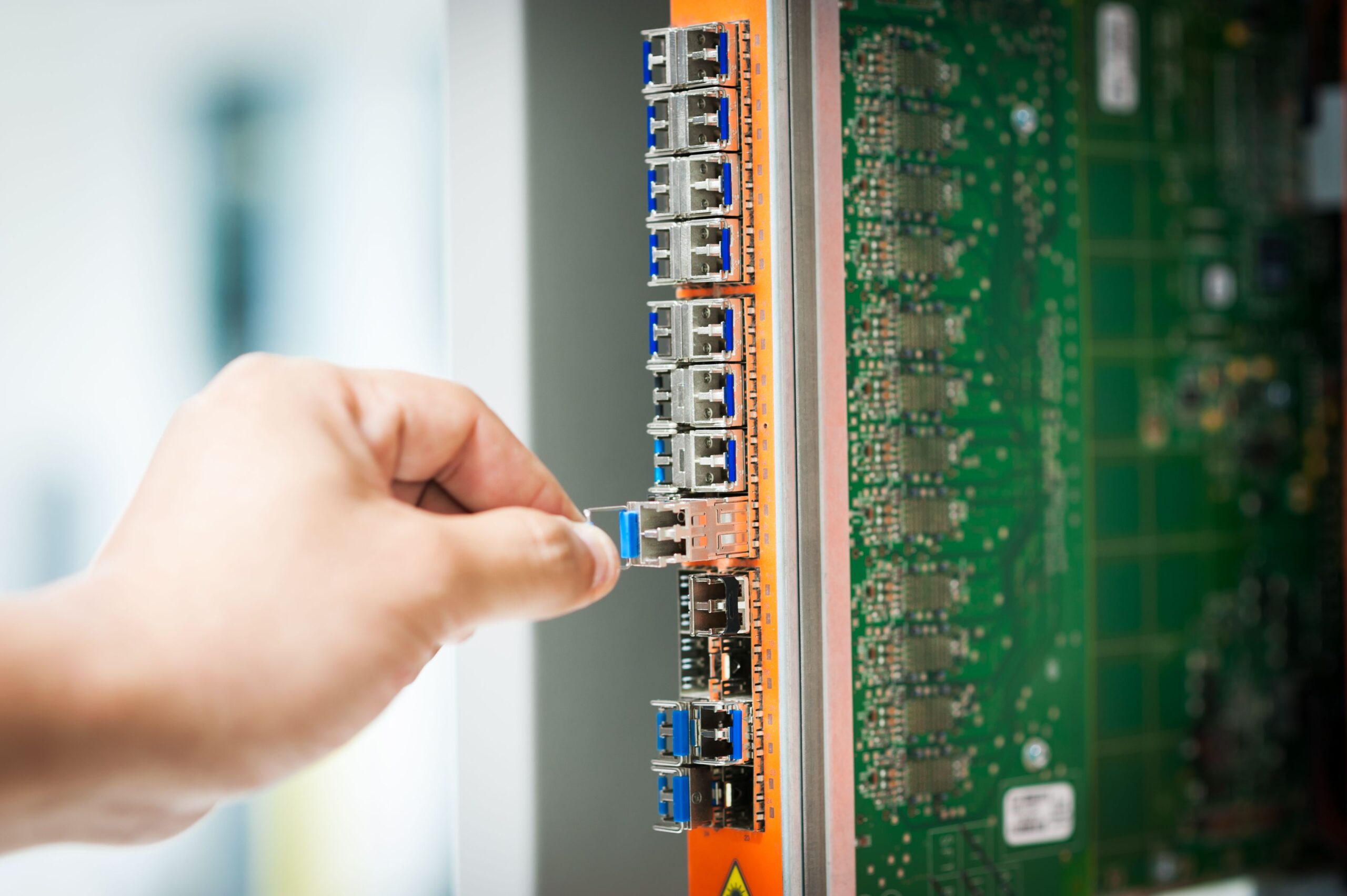
The transition from 100G to 400G networks is one of the most important steps in modern data center evolution, driven by the explosive growth of AI workloads, cloud computing, and high-performance distributed applications. At the center of this transition are 400G OSFP modules, which provide the bandwidth density and scalability required for next-generation switching fabrics. These modules are designed to support high-speed optical interconnects that can efficiently handle massive east-west traffic inside hyperscale environments.
Among the most widely deployed solutions, 400G OSFP modules play a critical role in enabling high-throughput spine-leaf architectures. They allow data centers to scale bandwidth without dramatically increasing power consumption or rack space. As networks grow, operators need a migration path that avoids costly redesigns, and this is where breakout capabilities become especially important.
In many modern AI and cloud infrastructures, 400G OSFP modules are deployed not just as standalone high-speed links but also as flexible aggregation points that can connect multiple 100G endpoints. This flexibility is essential for bridging legacy 100G systems with new 400G infrastructure while maintaining operational continuity.
Understanding 400G DR4 Architecture and Breakout Design
The 400G DR4 architecture is based on four parallel optical lanes, each operating at 100G PAM4 signaling over 1310nm wavelength single-mode fiber. This configuration enables a total throughput of 400Gbps while maintaining relatively simple optical design and efficient power consumption. The use of MPO-12/APC connectors allows all four lanes to be transmitted simultaneously over a compact multi-fiber interface, making cabling more structured and manageable in dense data center environments.
A key advantage of the DR4 design is its inherent support for breakout functionality. A single 400G port can be split into four independent 100G-DR connections, effectively transforming one high-speed interface into multiple lower-speed links. This is particularly useful in environments where existing 100G switches, NICs, or servers are still widely deployed but need to be integrated into a higher-speed fabric.
This breakout capability significantly improves port utilization efficiency. Instead of deploying separate 100G uplinks for each device, operators can use a single 400G OSFP port as an aggregation point. This reduces switch port consumption, simplifies cabling design, and allows for a more gradual and cost-effective migration path toward full 400G adoption.
Why Breakout Is Essential for 100G to 400G Migration
Migrating directly from 100G to 400G across an entire data center is often impractical due to cost, compatibility, and infrastructure constraints. Many existing systems, including servers, storage nodes, and leaf switches, are still optimized for 100G connectivity. Without a transitional mechanism, operators would face a disruptive and expensive overhaul of their entire network architecture.
400G DR4 breakout solves this challenge by acting as a bridge between generations. By enabling one 400G port to connect four 100G endpoints, it allows incremental upgrades rather than full-scale replacement. This staged migration approach reduces capital expenditure while maintaining network performance and scalability.
In addition, breakout configurations simplify traffic engineering within the data center. Instead of redesigning entire network layers, operators can reuse existing 100G infrastructure while progressively upgrading spine and aggregation layers to 400G. This reduces operational risk and ensures stable network performance during transition phases, which is especially important for AI training clusters and cloud workloads that require continuous uptime.
Network Architecture Benefits of 400G Breakout Deployment
From a spine-leaf perspective, 400G DR4 breakout provides a highly efficient way to increase network density without increasing physical complexity. A single spine switch equipped with 400G OSFP ports can serve multiple leaf switches operating at 100G, significantly reducing the number of required uplinks while maintaining full bandwidth availability across the fabric.
This design also improves scalability in large-scale AI clusters. As GPU clusters grow, the need for high-bandwidth east-west communication increases rapidly. Breakout allows network architects to allocate bandwidth dynamically, ensuring that critical compute nodes receive sufficient connectivity without overprovisioning entire network layers.
Another important advantage is improved cabling management. By using MPO-12-based DR4 connections, data centers can reduce the number of discrete fiber runs required compared to traditional 100G deployments. This leads to cleaner rack layouts, improved airflow, and easier maintenance, all of which are critical in high-density environments where thermal management is a key concern.
Efficiency Gains in Cost, Power, and Port Utilization
One of the most significant benefits of 400G DR4 breakout is cost efficiency. Instead of purchasing multiple 100G transceivers and allocating separate switch ports, operators can use a single 400G OSFP port to achieve the same connectivity. This reduces both hardware costs and ongoing operational expenses related to power and cooling.
Power efficiency is also improved at the system level. Although 400G modules consume more power per device compared to 100G modules, the consolidation of multiple links into a single optical module reduces total power per gigabit. This is particularly important in large-scale deployments where thousands of transceivers are used simultaneously.
Furthermore, port utilization efficiency is greatly enhanced. High-end switches often have limited port density at higher speeds, and breakout allows each 400G port to be fully utilized instead of being dedicated to a single high-speed connection. This ensures that expensive switching resources are used more effectively across the entire network.
Practical Deployment Scenarios in AI and Cloud Data Centers
In AI training clusters, 400G DR4 breakout is commonly used to connect GPU servers operating at 100G NIC speeds to high-speed spine switches. This ensures that compute nodes can communicate efficiently without requiring immediate upgrades to 400G interfaces on every server.
In cloud data centers, breakout is often deployed in aggregation layers where traffic from multiple 100G leaf switches is consolidated into 400G uplinks. This allows operators to scale bandwidth vertically while keeping existing horizontal infrastructure intact.
High-performance computing environments also benefit from this approach, particularly in scientific simulations and distributed workloads where data movement between nodes is frequent and latency-sensitive. By using breakout, these systems can gradually evolve toward higher-speed architectures without interrupting ongoing computational tasks.
Conclusion
The transition to 400G networking is not just a technological upgrade but a structural evolution of data center architecture. 400G DR4 breakout provides a practical and efficient bridge between legacy 100G systems and next-generation 400G infrastructures, enabling smooth migration without disruptive overhauls.
By combining flexible bandwidth allocation, simplified cabling, and improved port efficiency, 400G OSFP modules with DR4 breakout functionality have become a foundational technology in modern AI and cloud data centers. As demand for bandwidth continues to grow, this migration strategy will remain essential for achieving scalable, cost-effective, and future-ready network design.
I think, therefore I am. I can resist everything except temptation. The fear of death follows from the fear of life.