AI writing tools can produce a 1,500-word article in under a minute. That speed has changed content marketing, and it has also raised a serious question: is AI content good enough to rank, convert, and earn trust, or does human writing still win?
The honest answer is that it depends on how you use each one. In this guide, we break down the real differences between AI content and human content, what Google actually says about both, and how to build a workflow that uses the strengths of each.
What Is AI Content?
AI content is text generated by large language models such as ChatGPT, Claude, or Gemini. You give the tool a prompt, and it produces an article, product description, email, or social post based on patterns learned from huge amounts of existing text.
AI content comes in two forms:
- Fully AI-generated: The tool writes everything, and the text is published with little or no changes.
- AI-assisted: A person uses AI for outlines, drafts, or ideas, then edits and improves the result.
This difference matters a lot, and we will come back to it.
What Is Human Content?
Human content is written by a person who draws on real experience, research, opinion, and audience understanding. It may still use tools like spell checkers, keyword planners, or grammar software, but the ideas, structure, and voice come from the writer.
AI Content vs Human Content: Key Differences
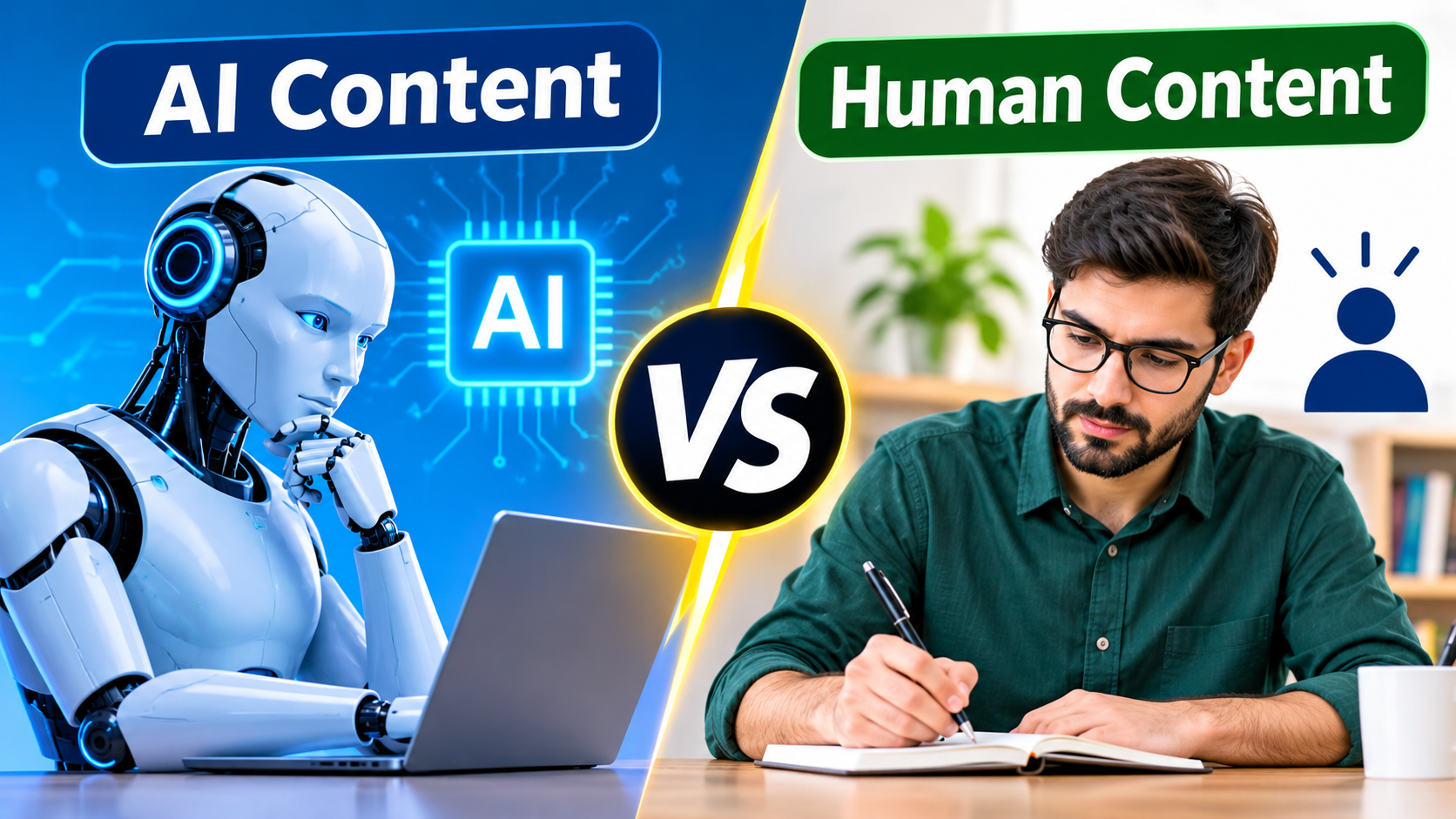
AI content and human content differ in six main areas: speed, cost, originality, accuracy, tone, and consistency.
AI is strongest where volume and efficiency matter, while humans are strongest where experience, trust, and emotional connection matter. Here is how each factor compares.
1. Speed and Scale
AI wins here without question. A task that takes a human writer several hours can be drafted by AI in minutes. For teams that need hundreds of product descriptions, FAQs, or category pages, this is a major advantage.
2. Cost
AI is cheaper per word. A professional writer charges for time, research, and expertise. AI tools charge a small monthly fee. However, cheap content that needs heavy editing, fact-checking, or rewriting can end up costing more than it saves.
3. Originality and Insight
This is where humans lead. AI predicts what words are likely to come next based on existing material, so it tends to repeat common ideas. A human writer can share a personal case study, a contrarian view, or lessons from real client work. These are the things readers remember and share.
4. Accuracy and Fact-Checking
AI can state false information with total confidence, including made-up statistics, fake quotes, and outdated facts. Human writers make mistakes too, but they can verify sources, call experts, and take responsibility for what they publish.
5. Tone and Emotional Connection
AI can imitate a brand voice, but it often sounds smooth and generic. Humans bring humor, empathy, storytelling, and cultural awareness. For content that needs to persuade or build loyalty, that emotional layer matters.
6. Consistency
AI is consistent in format and grammar and never has a bad day. Humans vary in quality, but a good editor can keep a team consistent too.
Quick Comparison Table
| Factor | AI Content | Human Content |
| Speed | Very fast | Slower |
| Cost | Low | Higher |
| Originality | Limited, pattern-based | High, experience-based |
| Fact accuracy | Needs verification | Can be verified and owned |
| Emotional depth | Basic | Strong |
| Scalability | Excellent | Limited by team size |
| Trust and authority | Weak without editing | Strong |
What Does Google Say About AI Content?
Google has said that it rewards helpful, people-first content regardless of how it is produced. The method of creation is not the issue. The issue is quality. Content created mainly to manipulate rankings, including mass-produced AI pages with no real value, goes against Google’s spam policies.
Google also looks for signals of E-E-A-T: Experience, Expertise, Authoritativeness, and Trustworthiness. Because AI has no real-life experience, purely AI-written content often struggles to show these signals. Human input such as author bios, original examples, and expert review helps close that gap.
The takeaway: AI content is not banned, but low-effort AI content is unlikely to perform well over time.
Pros and Cons at a Glance
AI content: pros
- Fast drafting and easy scaling
- Low cost
- Useful for outlines, research starting points, and repetitive formats
AI content: cons
- Generic tone and repeated phrasing
- Risk of factual errors
- No first-hand experience
- Can look the same as competitors’ content
Human content: pros
- Original ideas and real experience
- Stronger voice and emotional connection
- Higher trust and authority
Human content: cons
- Slower and more expensive
- Harder to scale
- Quality depends on the writer
The Best Approach: AI-Assisted Human Content
Most successful content teams no longer treat this as a choice between AI and humans. They combine both. Here is a simple workflow:
- Research and plan with a human. Choose the keyword, search intent, and angle yourself.
- Use AI for the first draft or outline. Let it handle structure and basic explanations.
- Add human expertise. Insert original examples, data, quotes, and opinions.
- Fact-check everything. Verify every statistic, claim, and link.
- Edit for voice. Remove robotic phrases and rewrite the intro and conclusion in your own words.
- Optimize for SEO. Check headings, internal links, meta tags, and readability.
This approach keeps the speed of AI while protecting the quality and trust that only humans can provide.
When to Use AI and When to Use Humans
Best uses for AI:
- Outlines and content briefs
- Product descriptions at scale
- Meta descriptions and title ideas
- Summaries and first drafts
Best uses for human writers:
- Thought leadership and opinion pieces
- Case studies and interviews
- Guest posts that build authority
- Brand storytelling and sales pages
- Sensitive topics such as health, finance, and legal advice
Final Thoughts
AI content is a powerful tool, but it is a tool, not a replacement for human thinking. Pure AI content is fast but often forgettable. Pure human content is authentic but hard to scale. The strongest results come from blending the two: let AI handle the heavy lifting, and let humans supply the insight, experience, and trust.
If your goal is to rank, earn backlinks, and build a real audience, focus less on who or what wrote the content and more on one question: is this genuinely useful to the reader?
FAQs
Can Google detect AI content? Google focuses on content quality rather than detecting how it was written. Low-quality, unhelpful content can be demoted whether a human or AI wrote it.
Will AI replace human writers? AI will change how writers work, but it cannot replace first-hand experience, original thinking, and real relationships with readers.
Is AI content bad for SEO? Not by itself. Unedited, generic, or inaccurate AI content is bad for SEO. Well-edited, helpful AI-assisted content can perform well.
Should I disclose that I used AI? Rules vary by platform and publisher. Being transparent builds trust, and some guest post sites require disclosure.