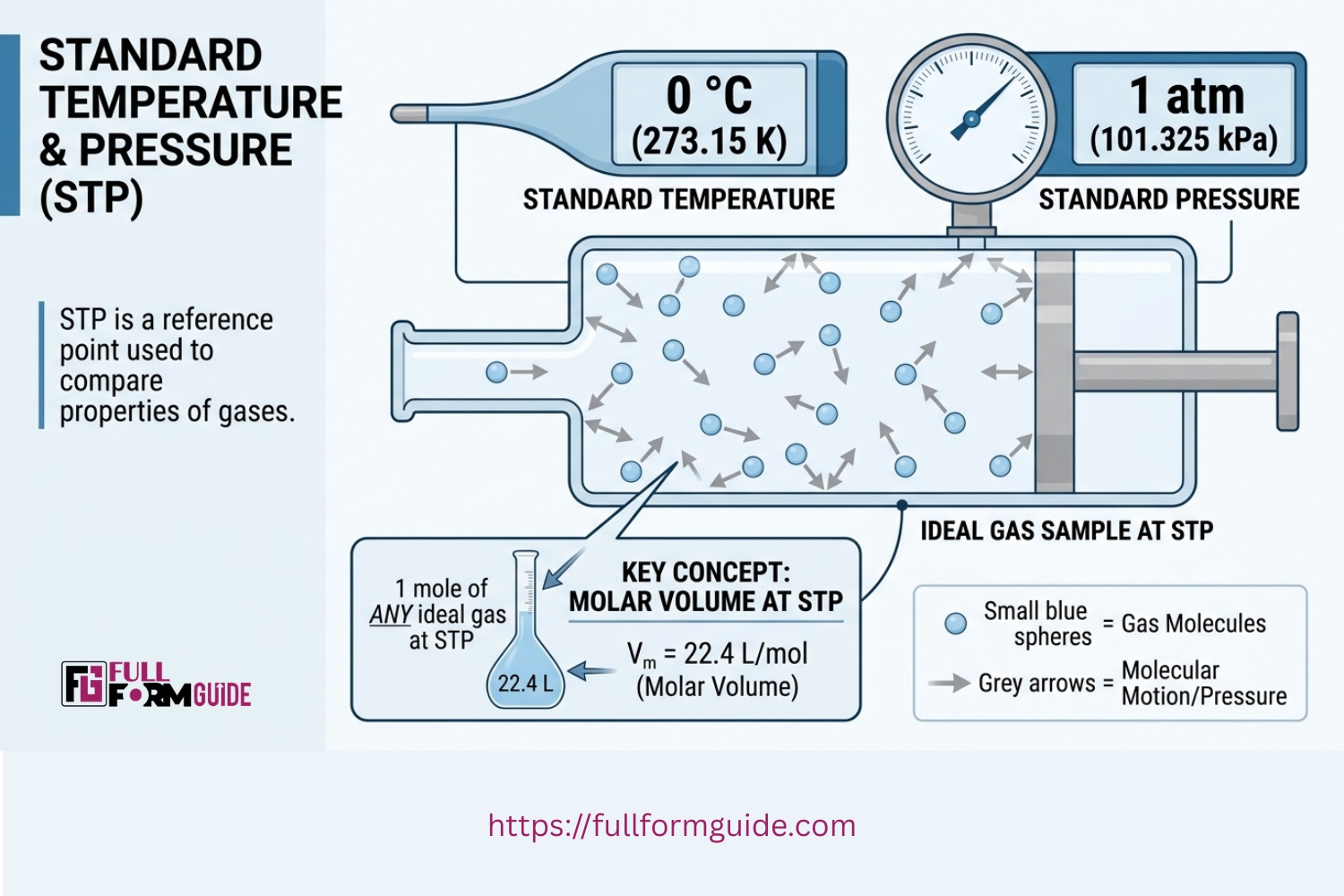
STP Full Form in Chemistry means Standard Temperature and Pressure. It refers to fixed environmental conditions used by scientists. It uses a standard temperature of 0°C, which is 273 Kelvin. The standard pressure is 1 atm or 760 mmHg.
The air we breathe (हवा) changes its properties with temperature and pressure changes. It expands when heated and compresses when pressure increases. Therefore, scientists selected STP so everyone can compare gas volumes easily.
At STP, one mole of any ideal gas occupies 22.4 liters. It is an important value and students must remember it during numerical questions. Many gas laws, like Boyle’s law and Charles’s law depend on such fixed values. STP ensures every experiment follows one clear measurement rule.
Importance of Chemistry
Understanding scientific terms can be confusing for many students. Most learners search for simple and clear answers when it comes to chemistry. Many people ask what the STP Full Form in Chemistry is and why it matters.
The STP full form in Chemistry stands for Standard Temperature and Pressure. It acts as a reference point in chemistry to measure gases under fixed conditions. Whenever students deal with gas laws, calculations, and experiments, they must understand STP clearly (स्पष्ट).
Chemistry uses many measurable standards to compare results globally. Without standard values, it would be difficult to measure gases accurately. So STP plays a very important role in making chemical calculations easy and correct. Many exams also include questions related to STP. Therefore, knowing its meaning gives confidence while solving problems.
Why STP is Used in Chemistry Calculations
It becomes difficult to calculate gas results under changing laboratory conditions. Pressure may rise or fall in different locations. Temperature also changes every hour in many cities. So, chemists needed a single constant rule.
STP helps to perform gas calculations without confusion (उलझन). Students can measure gas density, volume, and mole values with easy formulas. It also helps industries to design safe gas storage systems and cylinders.
Gas behavior changes when compressing or heating. STP provides a baseline where all gases behave similarly according to science rules. It also supports researchers when comparing results from one lab to another. It saves time and prevents errors in real experiments.
STP in Gas Laws and Molar Volume
Gas laws explain how temperature, volume, and pressure are related. STP values help in these laws. Boyle’s law shows the pressure and volume relationship. Charles’s law shows the volume and temperature relationship. Avogadro’s law connects moles and volume. All laws become easy to understand when using STP values.
Molar volume is another important concept in chemistry. At STP, one mole of gas occupies a standard volume. It gives students a strong base while solving chemical equations. It also helps in calculating gas molecules present in a container. It supports the idea that equal volumes of gases at STP contain the same number of molecules, no matter what gas it is.
STP vs NTP Differences
It is very important to know that STP is different from NTP. Many students get confused between these two. NTP stands for Normal Temperature and Pressure. It has a temperature of 20°C or 293 K. Pressure remains the same as STP, which is 1 atm. Gas volume at NTP is different from STP. At NTP, one mole of gas occupies nearly 24 liters. So, both standards are used in different chemical studies.
Remembering these differences avoids calculation mistakes in exams. Chemistry needs accurate values, so use the correct reference condition while solving.
Importance of STP in Daily Life and Industry
Many industries deal with gases daily, like oxygen cylinders, LPG, and nitrogen tanks. Factories use STP values while filling gases so cylinders remain safe. Gas suppliers follow these standards to maintain the correct quantity. STP is also used in environmental studies where carbon dioxide and other gases are measured.
Doctors need oxygen cylinders with the right pressure during emergencies. Engineers use gas rules for safe airplane and vehicle design. So STP helps in daily life more than we notice.
Conclusion
STP Full Form in Chemistry means Standard Temperature and Pressure. It gives a clear and constant way to measure gases. Students must remember that STP has 0°C temperature, 1 atm pressure, and a molar volume of 22.4 liters.
Furthermore, it supports gas laws, calculations, and industrial applications. Understanding STP makes chemistry easier and builds a strong scientific foundation (मजबूत आधार).