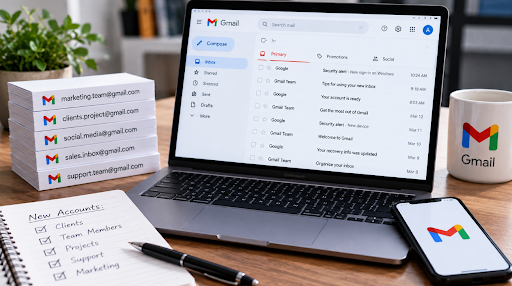
Bulk Gmail PVA accounts are typically presented as packages containing many email profiles at a single listed price. Quantity may be easy to compare, but the administrative risks grow as more logins, recovery options and access records are involved. A commercial example is the bulk Gmail PVA account package range on PVAInfo, which lets readers see how sellers group account counts. Before calculating a discount, however, determine whether acquiring third-party consumer accounts is permitted and necessary for your use case.
Most legitimate organizations do not need hundreds of unrelated personal inboxes to run their email operations. They need a way to create authorized identities, grant appropriate access, secure information and reliably handle employee departures. A large package can look economical on a per-account basis while introducing considerable work in verification, documentation and recovery. The right planning unit is therefore the complete email workflow, not the raw number of addresses.
The Gmail PVA package comparison at PVA Provider offers another view of quantity-based listings. These pages can help identify the questions to ask about product scope and price, but they cannot guarantee future access or compliance. If the underlying purpose is business communication, compare the cost of managed accounts, aliases and shared mailboxes before considering any external account inventory. Better account governance often saves more time than a small upfront discount.
Define the Real Business Requirement First
Start with the work that email must support. A customer service team may require a shared inbox, role-based access and assignment history. A sales team may need individually identifiable employees and records tied to a customer system. A project group may only need aliases attached to existing identities. Once the workflow is written down, it often becomes clear that the solution is not equivalent to buying one account for every message or task.
Document the number of legitimate users, the volume and sensitivity of messages, retention needs and the authority to access each mailbox. This gives procurement a useful specification. It also helps security teams identify whether consumer Gmail, Google Workspace or another service can meet the requirement. Avoid designing around numerical limits by creating extra accounts solely to defeat platform controls; such shortcuts are fragile and may violate service rules.
Understand Package Pricing and Hidden Costs
Unit pricing is the advertised package price divided by the number of profiles. That figure can reveal whether a larger bundle appears cheaper, but it ignores setup time, record keeping, credential storage, support and possible access failures. The financial impact of one unavailable account varies widely depending on whether it contains important conversations or merely a test message. Procurement should consider operational consequences rather than focus exclusively on the lowest arithmetic price.
A responsible comparison includes transparent terms, a support process, data-handling assurances and a clear statement of what is being delivered. Check whether the offered accounts can lawfully be transferred and whether recovery controls can be retained by the authorized operator. Claims that bulk packages cannot be restricted or will always pass verification should be discounted. No seller can override another platform’s future security decisions.
Keep Credentials and Ownership Traceable
Managing many credentials without structure can quickly become unsafe. Spreadsheets circulated through chat apps can expose entire collections if one device or conversation is compromised. Organizations should use approved identity systems and password management policies, with access granted only to specific staff. Every account should have a documented purpose and an accountable owner; otherwise unused profiles can accumulate unnoticed and create unnecessary security exposure.
Recovery procedures deserve equal attention. If nobody knows who controls the registered phone number, recovery email or passkey, an account cannot be considered operationally dependable. Keep records of who can approve changes and how access is removed when a staff member leaves. A managed directory is often better suited to this task than a set of consumer accounts with disconnected security settings.
Avoid Confusing Volume With Deliverability
Email providers look at behavior and compliance, not simply the number of addresses in a package. Distributing unsolicited messages across numerous inboxes does not make that activity acceptable. Consent, sender identity and recipient expectations remain central to responsible communication. Attempts to evade sending restrictions can damage reputation and trigger account enforcement, making large collections an especially poor substitute for a legitimate email delivery platform.
Organizations sending newsletters or transactional notices should evaluate specialized systems with appropriate authorization, unsubscribe management and monitoring. For internal testing, use supported development environments and test addresses where possible. These approaches make it easier to observe failures, protect customer data and avoid sending real messages to unintended people. Scalability is best achieved through sound architecture rather than an ever-growing list of logins.
Evaluate Alternatives That Scale Cleanly
Google Workspace and comparable managed solutions can provide custom domains, administrator controls and predictable provisioning. Shared mailboxes, groups and aliases often cover requirements that otherwise appear to need separate accounts. Modern collaboration tools can also route requests to the right team without exposing a common password. These options are worth comparing because they align access rights with real people and business responsibilities.
The comparison should include subscriptions, security administration, help-desk effort and the consequences of downtime. A system that costs slightly more but offers simple recovery and clear employee offboarding may provide substantially better value. Whenever sensitive customer information is involved, predictable auditability should carry more weight than a headline package size. A documented evaluation can protect both budget and reputation.
Conclusion: Manage Email as an Ongoing Service
Bulk Gmail PVA listings are easy to compare by quantity, but that is only a small part of the decision. Strong planning begins with a legitimate need, clearly assigned ownership, security control and realistic total cost. Consumer account transfers may introduce policy and recovery uncertainties that become more significant at scale. No package size can compensate for missing governance or an unsuitable business process.
Rather than starting with the largest available bundle, design the email system around authorized users and the information they handle. Choose services that offer transparent administration, stable support and a workable exit plan. Whether the final setup uses a few personal accounts or managed organizational mailboxes, maintaining control and respecting platform rules matter far more than the number of credentials delivered.