Most UAE business owners wait until they are staring at an acquisition offer or a term sheet from an investor to ask, “What is my business actually worth?” It is a classic trap. By the time you need the number, you have little room to change it. You become a price taker rather than a value creator, reacting to a buyer’s assessment instead of driving your own narrative.
Business valuation in the UAE is far more than a dry accounting exercise; it is a strategic maneuver that dictates your future exit, your leverage in negotiations, and your ability to attract top-tier capital. Whether you are eyeing an exit in the next five years or simply want to understand the health of your asset, you need to see your company through the eyes of an investor. Two identical businesses often command wildly different price tags, and the difference usually comes down to timing, financial transparency, and structural maturity.
What Business Valuation Really Means in the UAE Context?
At its core, a valuation provides a reasoned estimate of a company’s economic worth. However, it is never a single, fixed number. It is a snapshot of expectations. An investor doesn’t pay you for what you did yesterday; they pay you for what they believe your business will generate tomorrow.
In the UAE, the market brings unique nuances. You are operating in an ecosystem defined by a mix of Mainland and Free Zone structures, a highly mobile expatriate talent pool, and a disproportionate number of SMEs compared to established conglomerates. A valuation here must account for these regulatory environments. You aren’t just selling a balance sheet; you are selling a position within a specific jurisdiction that carries its own tax and operational implications.
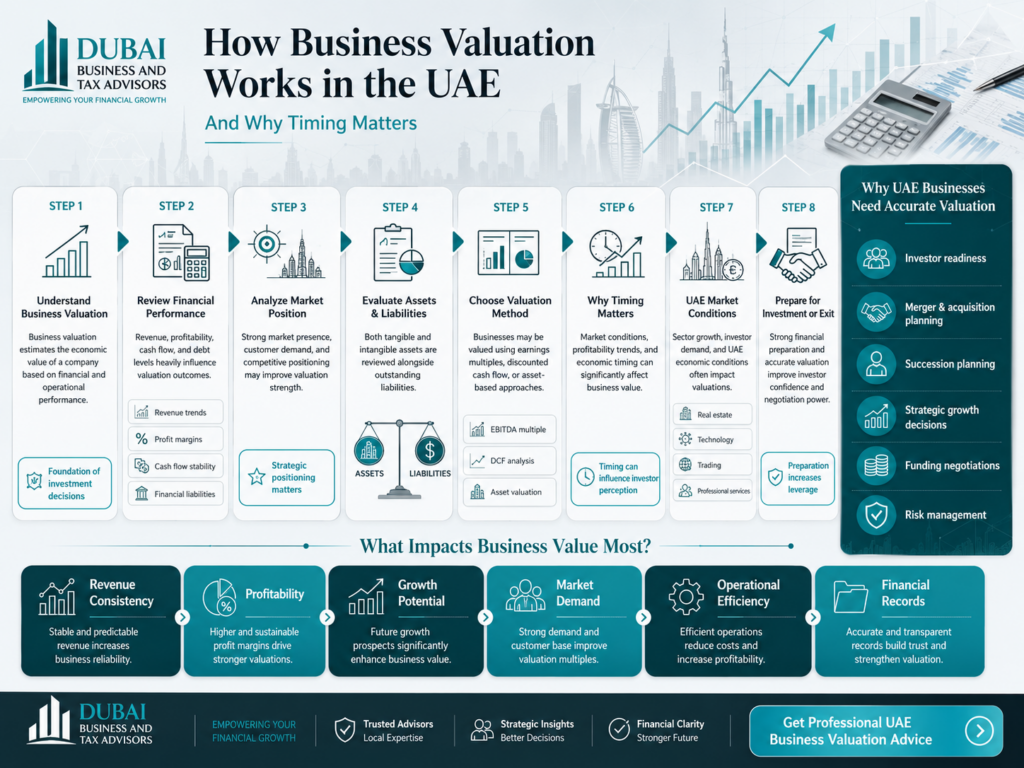
How Business Valuation Actually Works in the UAE?
When a professional appraises a business, they generally rely on three frameworks. The right choice depends entirely on your industry and stage of growth.
The Income-Based Approach
This is the most prevalent method for established, profitable firms. It focuses on the future. The most common metric here is the EBITDA multiple. If your business generates AED 2 million in EBITDA, a buyer might apply a multiple of 4x to arrive at an AED 8 million valuation. More complex businesses use Discounted Cash Flow (DCF) analysis, which projects future cash flows and “discounts” them to present-day value based on perceived risk.
The Asset-Based Approach
For companies that hold significant physical inventory, real estate, or heavy machinery, the value often resides in the assets themselves. This method calculates the net value of all tangible assets minus liabilities. It is less common for service-based businesses, where the value is in the human capital and contracts, but it serves as a “floor” price for manufacturing or trading entities.
The Market-Based Approach
Here, the valuation relies on comparables. If similar firms in your industry were recently sold in Dubai or Abu Dhabi, those transactions set the benchmark. It is a logic of “what did the neighbor get?”simple to understand but often difficult to execute due to the lack of public transaction data in the private SME sector.
The Real Drivers of Business Value
If you want to move the needle on your business valuation UAE experts look at, you need to focus on what actually creates “buyer confidence.”
- Profitability Quality: Revenue is vanity; profit is sanity. Buyers want to see sustainable margins, not erratic spikes driven by one-off deals.
- Recurring Revenue: A subscription-based model is worth significantly more than a project-based one. Predictability is the enemy of risk, and buyers pay a premium for reduced risk.
- Customer Concentration: If your largest client accounts for 40% of your revenue, you have a massive valuation discount. You aren’t a business; you are a service department for that client.
- Founder Dependency: If the business stops working the moment you take a vacation, you don’t have a sellable asset. You have a job. The goal is to build a business that functions independently of your daily presence.
- Reporting Quality: Audited financials are the gold standard. They signal that your numbers have been vetted, providing a layer of trust that unmanaged books can never match.
Why Timing Matters More Than You Realize?
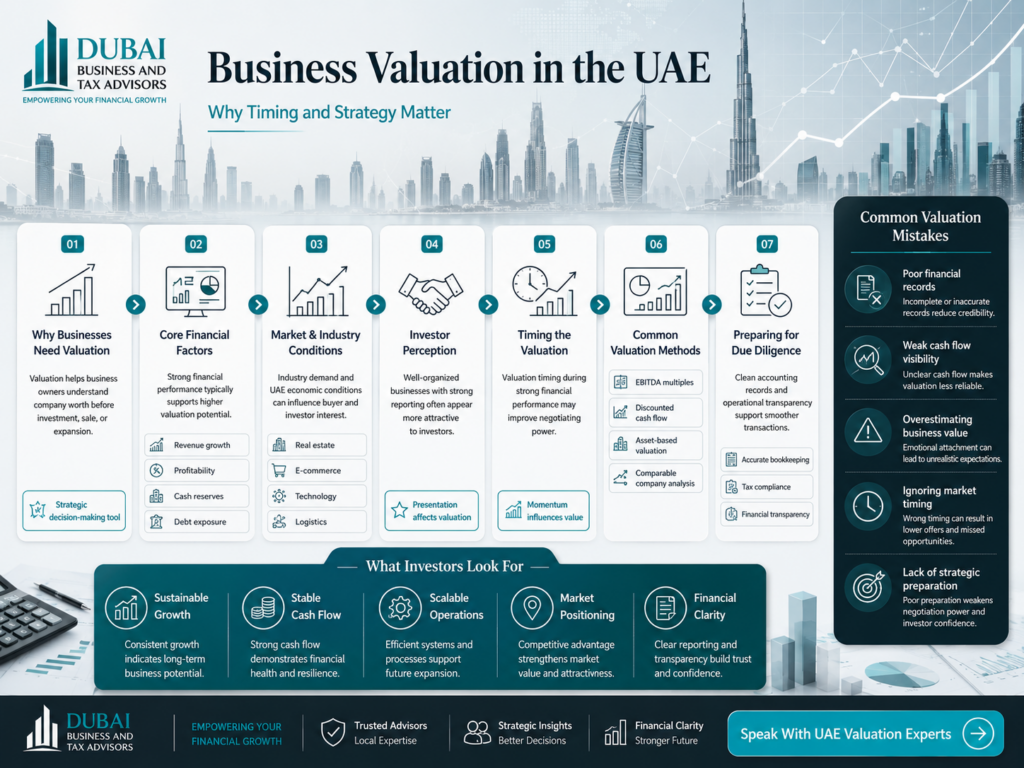
Valuation is a moment-in-time snapshot of future expectations. If you sell during a dip, you are selling at the bottom of a cycle. If you sell when you are scaling, you are selling the potential for exponential growth.
Many owners try to exit when the business is struggling, hoping to “cut their losses.” This is the worst possible timing. Buyers sense distress and discount your valuation accordingly. Conversely, the best time to get a valuation is when your growth curve is steepening. You want to bring an investor in when the success of your recent expansion is clear, but the full profit potential is still ahead of you. That is the “sweet spot” where you maximize your leverage.
When Should You Get a Valuation?
Do not wait for a buyer to knock on your door.
- Get a valuation when: You are preparing for a funding round, planning an exit strategy, restructuring for tax purposes, or dealing with partner disputes.
- Delay a valuation when: You are in the middle of a massive, disruptive infrastructure project or your revenue is temporarily distorted by a one-time event that does not represent your baseline.
A smart strategy involves an annual “check-up” valuation. It keeps you focused on the metrics that actually drive your company’s price.
What Buyers and Investors Actually Look For?
Investors aren’t just looking for growth; they are looking for the absence of “friction.” They want clean contracts, documented workflows, and a strong second-tier management team. They are effectively purchasing your system. If your “system” is just your own hard work, they will view it as a high-risk investment. Buyers discount uncertainty more than they reward growth. If they have to spend six months cleaning up your bookkeeping, they will deduct that cost from the price they offer you.
How to Increase Value Before a Sale?
You can increase your business value in 18 to 24 months if you focus on the right levers. First, formalize your contracts. Ensure your customer and supplier agreements are rock-solid and transferable. Second, diversify. If you rely on one client, hunt for three more. Third, document your processes. Create a “manual” for how your business runs so a buyer can see a blueprint rather than a mystery. Finally, clean up your balance sheet. Clear out bad debts, unnecessary personal expenses, and confusing inter-company loans.
Common Mistakes That Reduce Value
Mixing personal and business expenses is the fastest way to kill a valuation. It forces the buyer to “add back” expenses in a way that looks messy and unprofessional. Another common error is failing to maintain audited financials. In the UAE, particularly with the new Corporate Tax landscape, having unvetted, DIY accounts is a massive red flag. Investors will assume the “hidden” problems are worse than they actually are and bake a risk premium into their offer.
Industry-Specific Valuation Differences
- Consulting & Services: The value is in your retention rate. A 90% client retention rate is worth its weight in gold.
- E-commerce: Buyers look at customer acquisition costs (CAC) versus lifetime value (LTV). If you spend more to get a customer than they pay you over their lifetime, your valuation will be non-existent.
- Trading: Inventory turnover is key. If you are sitting on dead stock, that represents a massive hit to your cash and your valuation.
- Tech: Scalability is the only metric that matters. Can you add 10,000 users without adding 10,000 hours of manual labor?
Valuation in the UAE Corporate Tax Era
The introduction of Corporate Tax has fundamentally shifted how we look at valuation. Restructuring is now a vital planning tool. If you are moving shares, gifting equity, or merging entities, you need a professional valuation to determine tax liability. Ignoring the tax implications of your corporate structure can lead to massive, unexpected bills during a transfer. You must align your valuation strategy with your tax planning to avoid getting blindsided by the FTA.
Valuation Readiness Checklist
Before you engage anyone for a formal valuation, ensure you have these items ready:
- Audited Financial Statements: The last three years of profit and loss and balance sheets.
- Revenue Breakdown: Segmented by customer, product, and geography.
- Expense Normalization: A list of personal or non-recurring expenses that don’t belong in the core business.
- Corporate Structure: Clear legal documentation of ownership and inter-company agreements.
- Pipeline Data: A document showing future contracts or recurring revenue projections.
Frequently Asked Questions
What is business valuation and why do UAE businesses need it?
Business valuation is the process of determining the current economic worth of a company using financial analysis, market data, and industry benchmarks. In the UAE, businesses need a formal valuation for many reasons: selling or acquiring a business, attracting investors, securing financing, resolving shareholder disputes, or planning an exit strategy. With the UAE’s rapidly growing economy and increasingly sophisticated investment landscape, an accurate professional valuation is a critical tool for any business owner who wants to make confident, informed decisions about their company’s future.
What methods are commonly used to value a business in the UAE?
There are three primary approaches used by valuation professionals. The Income Approach values the business based on its ability to generate future earnings, typically using a Discounted Cash Flow model. The Market Approach compares your business to similar companies recently sold or publicly traded in the same industry. The Asset Approach calculates the net value of assets minus liabilities and is most common for asset-heavy businesses. In practice, a qualified professional will often combine these methods to arrive at the most accurate and defensible figure.
Why does timing matter so much when getting a business valued?
Timing can make an enormous difference to the outcome of a valuation, especially in a market as dynamic as the UAE. A valuation conducted during strong revenue growth, a recent contract win, or a booming sector will naturally reflect a higher worth than one done during a quiet period. Beyond market conditions, valuations carried out when your financial records are clean, your management team is stable, and your growth trajectory is clear will almost always produce a stronger result. Valuing your business at the wrong moment can leave significant value on the table.
How does the UAE’s business environment affect the valuation process?
The UAE presents unique considerations that directly influence how a business is valued. Factors such as your licence type, mainland or Free Zone status, ownership structure, and the transferability of key contracts all play a role. The introduction of Corporate Tax also adds a new dimension, as future tax liabilities must now be factored into earnings projections. Businesses operating in strategically important sectors such as technology, logistics, healthcare, and financial services may also attract a premium valuation due to stronger investor demand.
When is the right time to get a business valuation in the UAE?
The most common mistake is seeking a valuation only when already mid-transaction when a buyer has made an offer, a dispute has arisen, or a bank has requested one. By that point, your negotiating position is already limited. The right approach is to get a valuation done proactively, well before you need it. This gives you time to understand where your business stands, identify value-enhancing improvements, and enter any negotiation from a position of strength. Many experienced UAE business owners treat valuation as a regular health check, revisiting it every one to two years.
Conclusion
Business valuation is not just a calculation.it is a synthesis of timing, perception, and operational structure. It tells a story about where your business has been and, more importantly, where it is going.
The owners who achieve the best outcomes are never the ones who wait for a buyer to set the price. They are the ones who understand their own numbers, invest in transparency, and treat their company as an asset that needs to be exit-ready at all times. Plan early, focus on the drivers of value, and you will not just achieve a higher number, you will build a stronger, more profitable business in the process.
Dubai Business & Tax Advisors helps UAE business owners do exactly that. From financial record preparation and Corporate Tax structuring to business valuation support and exit planning, their team ensures that when the moment comes, you are leading the conversation not reacting to it.